
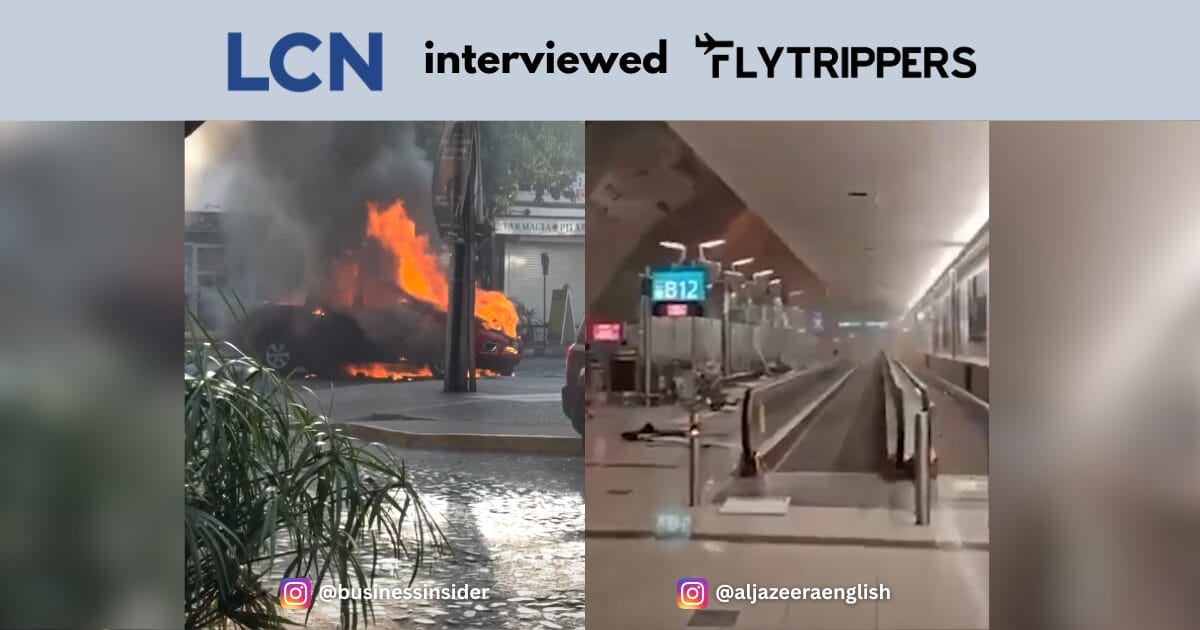
I am often interviewed by the media as a travel expert, and I just did 2 more TV interviews (since the Cuba one). I talked about how to deal with flight disruptions and how to stop overestimating the risk level, specifically for the 2 recent violent events in the Middle East and in Mexico. Speaking of, both of us co-founders have retired fathers going to those places this weekend…
I’m objectively very good at managing flight disruptions and properly contextualizing risks, thanks to having accumulated a lot of knowledge… and also a lot of experience. By the way, if your flights are never disrupted and you’re scared of everything, that really sucks for you.
Because it means you clearly don’t travel enough! It’s vital to know about this if you want to be a better traveler. Flytrippers aims to help you travel for less through our 3 types of content, namely flight deals, travel rewards, and tips/inspiration/news.
Here’s what I mentioned in my interviews (which aren’t available online) about flight disruptions and overestimated risks.
What should I know about flight disruptions?
Most travelers wait until a situation happens before becoming knowledgeable about this topic.
That’s obviously a terrible idea. Like literally everything in the world of travel, good preparation is the key to a better trip. The time to learn about how to deal with flight disruptions is before you leave!
We’ve talked about this a few times this year already, and I promised you a clearer guide where we’ll regroup all the tips you need to know.
(You can be the first to get it by joining the 100,000+ savvy Canadian travelers who receive Flytrippers’ free newsletter to get the best travel deals, tips, and content!)
In the Middle East, many major hubs have shut down, as safety is taken extremely seriously in aviation (that’s why it’s by far the safest transport mode). Over 10,000 flights were canceled.
In Mexico, flights from Canada to Puerto Vallarta and Guadalajara were cancelled for about 2 days.
Here are the 4 very basic tips I covered in my TV interviews:
- Free credit card insurance is the absolute best tip
- Airlines always owe you a free rebooking
- Take responsibility during disruptions
- Never cancel a flight in advance
Free credit card insurance is the absolute best tip
I still am completely flabbergasted by how many people don’t even know this amazing tip exists. I actually just shared how I easily got $1000 worth of free hotels and meals (and ≈ $200 in rewards), no questions asked, for my flight delay in NYC a few weeks ago.
That’s flight delay insurance, to give you free hotels and meals during disruptions. I’ve used it 10+ times, always getting hundreds of dollars with no questions asked!
Every. Single. Time.
This time I really maximized it, staying at an extremely fancy $700 hotel (earning thousands of Marriott Bonvoy points for future free travel, too)… and they reimbursed me in full, as always.
No human interaction involved for the claim! And no time wasted with airlines at all. And no terrible cheap hotel.
I’ll share a detailed guide about the insurance soon. I also shared a bit more info about this insurance in a recent post about flight disruptions.
But there’s also trip interruption insurance. So many people confuse the different types of free coverage (as so many people always confuse many concepts in the world of travel).
So if you were stuck anywhere due to a cancellation, that insurance will cover any flight to get home. Simple.
Airlines always owe you a free rebooking
It’s also very wild that so many people get scammed by airlines by accepting a refund instead of a free rebooking on another airline.
You can ALWAYS choose a free rebooking on another airline (for plane tickets to/from Canada). Of course, airlines don’t want you to choose that option, as it’s way more expensive for them than just refunding you.
Most people don’t know their rights and fall for accepting a refund and then have to pay for an extremely expensive flight on their own, when they should’ve gotten it for free…
Again, I covered that option in more detail in the post about flight disruptions.
Take responsibility during disruptions
I’ll share a detailed post about how I dealt with that NYC flight disruption, as it’s another great example of this tip. You’ve seen it if you follow my stories during my trips on my personal Instagram account.
Don’t be like most travelers who just go to an airline employee with a clueless deer-in-the-headlights look, begging for help and not doing anything to actually fix the situation yourself. Of course, you’ll get nowhere.
Find out which airline partners your airline has (on Wikipedia), then find flights for sale on those partner airlines, and then provide the flight numbers and dates to the employee. That’s it.
Take responsibility. Make it easy for them. They have hundreds of affected passengers at once. They won’t do everything for each one… they simply can’t, they don’t have time.
Give them the flight numbers, and they’ll rebook you. It really is that simple most of the time. Yelling at employees and being mad is useless (being mad and complaining never fixes anything in fact obviously, no matter the topic).
Never cancel a flight in advance
Even if you’re 100% sure you want to cancel a flight, it’s so unsavvy to cancel it in advance if there’s no free change offered.
You should always wait, and if the situation doesn’t get better, the airline might cancel your flight (now they’ll owe you a full cash refund, not a terrible travel credit), they might waive change fees (to save you money), or worst case, you just cancel it later instead of now…
And maybe a completely random storm will cancel your flight… and then again you’re owed a full cash refund.
What should I know about travel risks?
You should know that almost everyone always overestimates the risk level associated with travel.
And that while things can be scary (and that’s normal), that doesn’t mean it’s dangerous. Not at all.
It’s really important not to be a tourist who is irrationally scared of everything, if you want to be a real travel pro. It’s quite simply incompatible.
Please learn to at least put risks into context. Most people are objectively absolutely terrible at that. We want to help.
The situation was scary. Of course. It still is in the Middle East. It’s very fine to not want to got there, obviously!!! But that doesn’t mean it’s really dangerous everywhere there.
Being just “being scared” of something does not mean it’s unsafe. Some people are literally scared of clowns; does that mean that clowns are automatically dangerous? Of course not.
Being scared is a normal emotion, but that doesn’t make what you’re scared of unquestionably dangerous. You should still be rational, analyze facts, and gather more information. For any situation!
Here’s a quick look at both situations.
Middle East
The US and Israel attacked Iran. Iran is retaliating by firing back at plenty of neighboring countries.
Many won’t like to hear it, but it’s not any less true: the actual risk for civilians is objectively incredibly low in the countries where most travelers are (outside of Iran, Israel, Lebanon, and Iraq).
Literally no one has died in Qatar (0; ZERO), and right before my tips segment, they interviewed a random traveler who said he paid $15,000 to get out because “his life was priceless.” Zero deaths in the entire country, and literally no expert expects things to get worse there and in the United Arab Emirates…
Kevin, Flytrippers’ other cofounder, is in Amman, Jordan. Very close to the border with Israel. Exactly in between Israel and Iran.
He sees missiles intercepted every day… that doesn’t make it unsafe. Everyone has their own risk tolerance, of course. And it’s fine to have a lower one. But it doesn’t mean you’re right to think it’s risky.
He explained how the security situation really is on the ground in his intro to his current trip to Jordan.
They’re not hitting civilians! The odds of one hitting exactly where you’re located are microscopically tiny in the current situation. Lower than dying in a car accident in Canada.
Kevin’s retired father will even come to visit him in Jordan this weekend… Kevin obviously wouldn’t want that if it were actually unsafe!
Mexico
Authorities targeted a cartel leader in a major operation, and violence erupted in response to that (only in a few cities).
Again, objectively, the risk for civilians was incredibly low… empty buses and stores were set on fire, for example. A shelter-in-place order was given, and airports were shut down. Very scary, of course… but not dangerous at all, objectively.
No tourists (or even civilians) were targeted at all. Scary… but objectively way less dangerous than driving in Canada, statistically. Not a fun vacation (the only thing many who visit Mexico think travel is about), but again… not really dangerous (and it lasted a day…)!
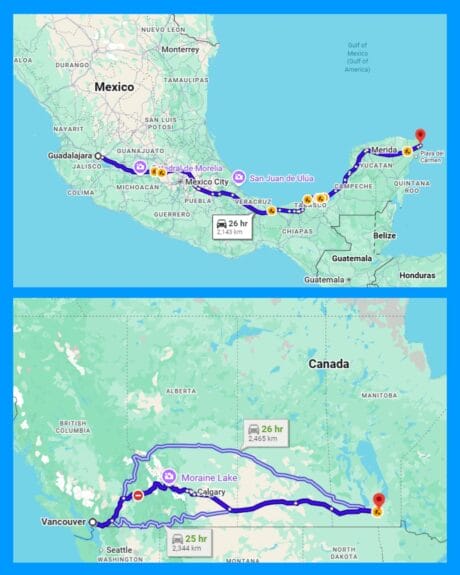
And it was only in a few places (especially in the state of Jalisco). Obviously not the whole country, which is bigger than Alberta, Saskatchewan, and Manitoba combined. And to be clear, things in Cancún, 2000+ kilometers away (it’s like Vancouver–Winnipeg), were nothing like they were there.
It’s also already completely over. It lasted for pretty much just a day, and yet people sadly won’t get over it for months (if not years).
My own retired father is going to Mexico this weekend… and obviously he’s not canceling. He’s not going to Jalisco, but even if he was, he would be fine: it’s over, and it wasn’t even really dangerous even when it was happening!!!
Learning how to travel for less
Join over 100,000 savvy Canadian travelers who already receive Flytrippers’ free newsletter so we can help you travel for less!
Summary
Flight disruptions happen all the time, unless you don’t travel (and not traveling is terrible). So just learn how to deal with them. And violence is obviously always scary, but that doesn’t mean you’re always actually at risk. It’s vital to understand the need to contextualize the risk level if you want to be a real travel pro.
What would you like to know about these TV interviews on flight disruptions in the Middle East and Mexico? Tell us in the comments below.
See the flight deals we spot: Cheap flights
Discover free travel with rewards: Travel rewards
Explore awesome destinations: Travel inspiration
Learn pro tricks: Travel tips
Featured image: Violence in Mexico and the Middle East (image credit: @businessinsider and @aljazeeraenglish, on Instagram)




Bonjour Andrew pour une toute première fois j’ai besoin d’aide je suis tes conseils depuis plusieurs années et ça m’a été très profitable juste en points j’ai gagné plus de 5000$ pour nos voyage j’ai fait plus de 70 pays jusqu’à maintenant mais là je suis pas sur de comment gérer la situation j’ai un vol de Shanghai à Doha le 26 mars avec QATAR AIRWAY 4 jours à Doha hôtel réserver et billet de soccer départ le 30 pour Montréal tout à été payé avec Scotia Amex et Marriott Qatar me propose d’annuler car pas d’autre alternative mes billets sont payés depuis plusieurs donc j’attend de voir comment gérer ça avec tes excellents conseils merci Sylvie p.s les billets d’avion on vraiment monté de prix
Bonjour Sylvie,
Super, c’est effectivement un monde merveilleux les récompenses-voyage 🙂 Et surtout pour aider à visiter plus de pays comme toi!!!
Alors la base de toutes les situations de changements de vols, c’est que c’est le transporteur doit annuler ton vol pour que tu ais droit à un rebooking gratuit.
Et c’est normal aussi quand on y pense, même si ça déplaît à plusieurs d’entendre les vérités qui font mal haha! S’ils opèrent le vol, ils n’ont pas besoin de te changer à un autre transporteur à leurs frais. Et s’ils opèrent le vol, c’est que c’est sécuritaire.
Si toi tu veux annuler ton vol, souvent dans des situations comme celle du moment les transporteurs offrent plus de flexibilité, comme ça semble être le cas selon ce que tu dis. Ils t’offrent un remboursement alors que les conditions de ta classe de tarifs ne permettraient peut-être pas ça.
Mais c’est sûr que c’est plate devoir attendre de voir s’il va être annulé. Mais c’est comme ça. À part le volet assurances, tu dois soit attendre et espérer. S’ils l’annulent, ils vont te devoir un rebooking gratuit sur un autre transporteur. S’ils n’annulent pas, tout va bien.
Ce que je ferais certainement, c’est annuler l’hôtel de Doha si tu as réservé une option entièrement remboursable (c’est presque toujours le cas; c’est l’avantage de toujours réserver de manière autonome soi-même, pas de forfaits ou de trucs du genre). Si c’est un forfait inclut avec le vol, ça ne se change peut-être pas, mais j’assume qu’ils rembourseraient si le vol est annulé (à vérifier dans les conditions). Les prix des hôtels sont certainement plus bas maintenant, donc tu pourras réserver de quoi de mieux si jamais tu prends le vol comme prévu.
Si tu as payé ton vol avec une bonne carte de crédit, tu as des assurances. Comme il y a maintenant un avis du gouvernement de ne pas aller au Qatar, tu as droit à un montant pour réserver un autre vol avec la plupart des cartes (si tu avais réservé avant que l’avis soit émis, évidemment). Ce serait à vérifier selon la carte.
Et oui, c’est bien normal que les prix aient augmenté à court-terme surtout. Plein de vols annulés qui réduisent la concurrence, et plein de gens qui ont peur de passer par la région et qui font en sorte que les alternatives sont plus en demande :S
Thank you for this honest and rational take on what happened in Mexico. I have lived in Sayulita, Mexico for 8 years with my three children. I feel so much safer here than Canada. We only live 45 minutes away from Puerto Vallarta (the city where some vehicles were set on fire). Absolutely zero civilians or tourists were in danger or attacked. The airport remained open, and the following day everything was returning back to normal. The news news greatly sensationalized everything.
Thank you for reading, and thanks for your perspective.
Indeed, the news always sensationalizes every single situation, and as experienced travelers we know this very well. You, as a local who was there, know it very well for this particular event. And yet so many people are criticizing us and think that they know better, while they’ve never even been to any of these places 😛
We’re trying to do our part to educate travelers about being better about this 🙂