 | Flytrippers cofounder |
Before the Iran ceasefire, I transited through Abu Dhabi (AUH) in the United Arab Emirates (my 4th time this year). This was on April 2, on my way from Jordan to Indonesia, right in the middle of the Iran-Israel conflict. Here’s how it actually was… even though it’s mostly irrelevant now, given the return to normal for most airline routes.
But showing you it was fine even during the war will help you see it’s fine now. If it weren’t safe to fly, they wouldn’t be flying. Airlines don’t mess around with actual safety risks.
Indeed, public perception often has nothing to do with the actual risk… as I know well, given my trip to Jordan. Flytrippers helps you travel for less with our 3 types of content, namely flight deals, travel rewards, and tips/inspiration/news.
Here’s what it was like to transit through Abu Dhabi in the United Arab Emirates.
Context of my transit in Abu Dhabi
Most airline routes in the major Gulf hubs have resumed normal operations, as Flytrippers’ other co-founder shared just before his own transit through Qatar last week.
He’ll write about his detailed experience as well, so I wanted to do it for mine in the meantime. It will surely reassure you.
My girlfriend and I needed to fly out after spending a few weeks in Jordan as planned; we were there before this war started.
I won’t repeat everything about my on-the-ground experience in the area just before this transit, but life in Jordan has been completely normal since this started. Literally no impact.
Every single Jordanian I talked to was completely unconcerned. Not in a naive way, just in a “we’ve lived through this before” way.
The United Arab Emirates (UAE) has seen more action than Jordan has. I wouldn’t say it was that much more risky or more dangerous, but just factually more intense.
Their own incidents were mostly drone interceptions near Dubai (and more frequently), but life there has also continued normally despite what you might have thought.
I wanted to share the reality of what it’s actually like, because the media made it sound like the entire Middle East was a no-fly zone… but many flights were always operating.

Now, with the ceasefire, even the risk that actually did exist (flight disruptions, not safety) is not really an issue anymore for most routes.
For example, Etihad is operating 70% of its prewar flights, and many travelers mistakenly interpret this as risky. The thing is, many routes have not yet restarted. Those that have restarted are operated in a stable, reliable manner.
My itinerary
We booked business-class flights from Amman (AMM) to Jakarta (CGK) via Abu Dhabi, on Royal Jordanian and Etihad.
We paid just 40,000 American Airlines AAdvantage miles and 117.2 USD in taxes, instead of 2276 CAD (per person).
As a Canadian, you can get AAdvantage miles by transferring your RBC Avion points (transfer rate of 1-to-0.7) or by getting US-issued credit cards.
That gave me a great value of 3.7¢ per RBC Avion point. Most people redeem them at 1¢/pt (by not transferring them). We’ll have a lot of content about that amazing program and the RBC Avion Visa Infinite Card very soon!
This flight was actually a change from my original plan. I was initially supposed to go to Syria after Jordan.
But with airspace complications making exit logistics tricky, we pivoted and headed to Asia early.
We wanted to avoid all risk of flight disruptions jeopardizing the exciting luxury hotel stays we had lined up 2 weeks later (you can follow them now in my personal Instagram stories).
My experience at Amman airport (AMM)
We got to Amman airport about 6 hours early. Probably sounds excessive, but when you have free access to VIP airport lounges, especially the pretty wonderful lounges in Amman, it’s actually great.
We had work to catch up on, so we might as well get free meals and drinks. Plus, we had a late check-out at the hotel thanks to our elite status, but only until 4 PM, and the flight was at midnight.
The airport was basically empty when we arrived. Amman is not a huge connecting hub like those in Abu Dhabi (AUH), Dubai (DXB), or Doha (DOH).
It picked up a bit as the evening went on, but never got crowded.
We heard our first air raid siren of the day as we got to the airport. That was a pretty relaxed day in terms of missiles in the Amman airspace. Everyone is used to them by now.
Considering the taxi driver’s skills, the ride to get to the airport was probably about 10x more dangerous (as is almost always the case, war or not)!
Security itself was completely normal. No extra screening, no heightened tension on the ground. The threats were coming from the sky anyway, not from within the airports.
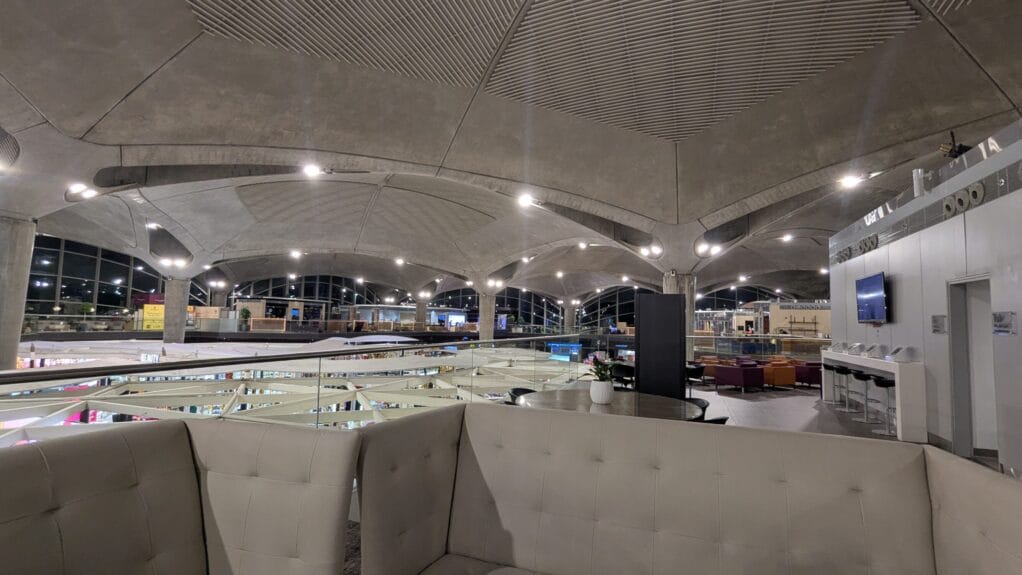
The (massive) lounge was empty when we got there and got slightly busier in the evening, but nothing compared to the usual North American lounge chaos (like everything else in the travel world, it’s so much better elsewhere).
My 1st flight (Amman–Abu Dhabi)
There was a slight schedule change. Our Royal Jordanian flight was pushed back 20 minutes. But otherwise, everything operated normally.
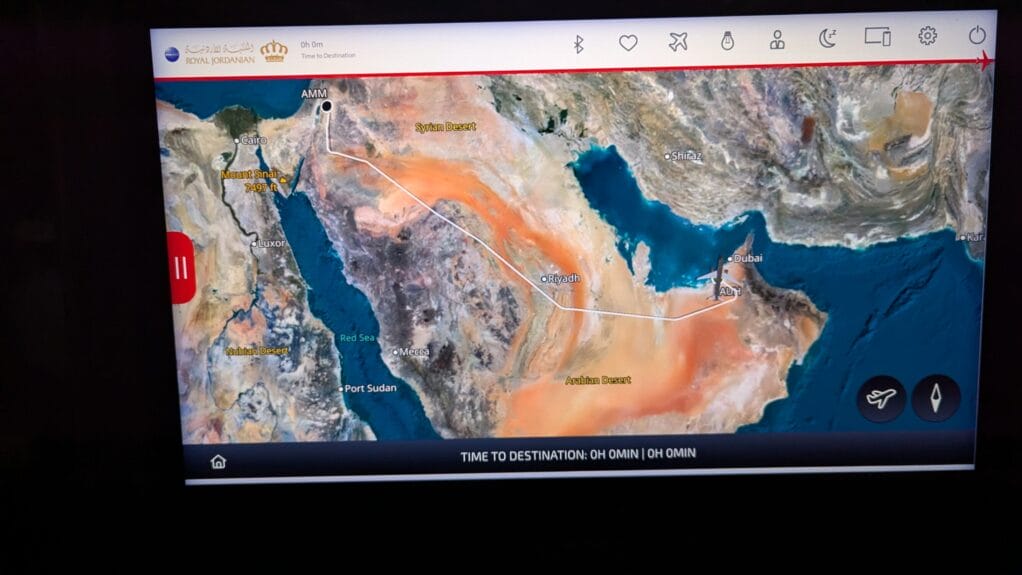
The flight path from Amman to Abu Dhabi wasn’t quite as direct as it probably usually is. I took a photo of the route on the seatback screen when we landed, and it looked as though we did a slight detour, but nothing dramatic.
The Amman–Abu Dhabi flight was a short 3.5-hour flight on the A320neo single-aisle aircraft.
If you read our guide to flying in business class for less than in economy class, you know that, unlike most twin-aisle planes, single-aisle planes usually don’t have a great business class with lie-flat seat beds.
The business class seats are just much wider and have more legroom. They were very spacious and comfortable, but didn’t recline at all.
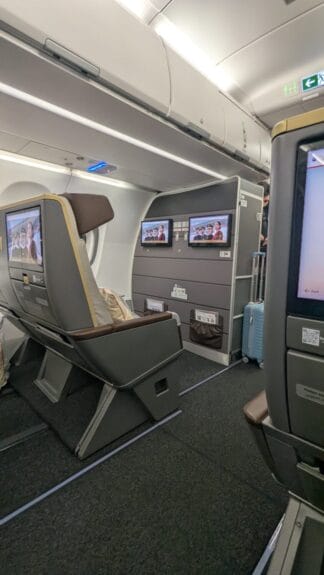
I usually prefer seats that don’t recline in economy class so they don’t recline into me, but on a nighttime business class flight, I would have liked to sleep a bit. I would have to wait for the next flight (and in the lounge).
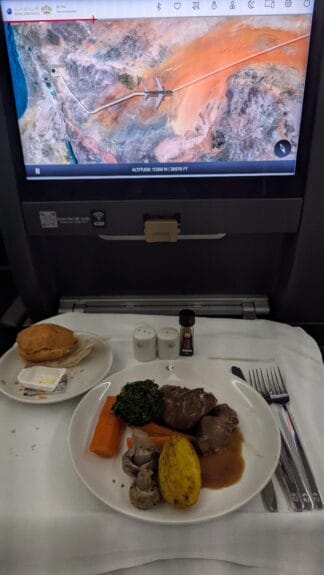
The Royal Jordanian service was great, and the food was also amazing, as is usually the case with business class.
Especially on higher-end Middle Eastern airlines.
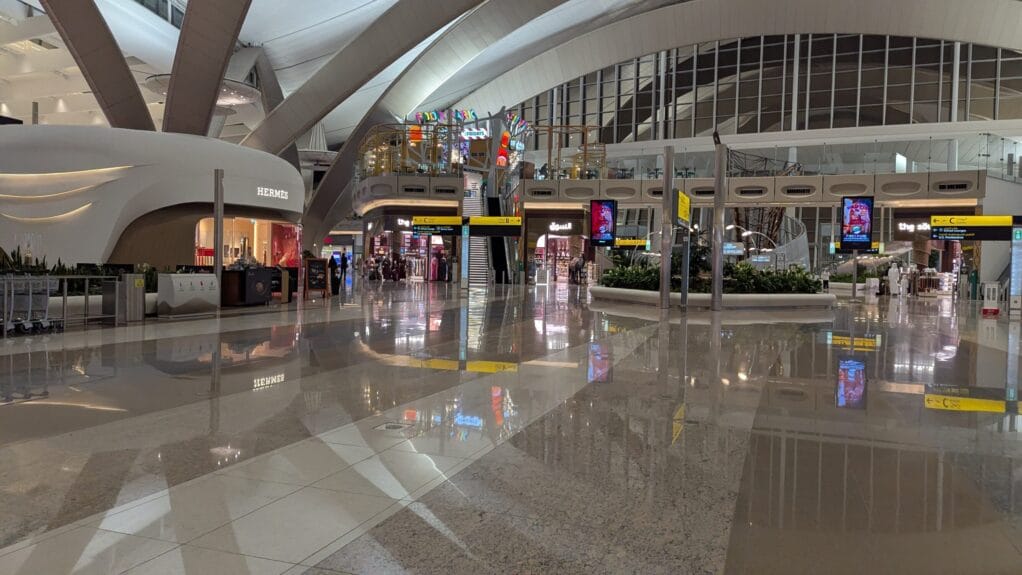
My experience at Abu Dhabi airport (AUH)
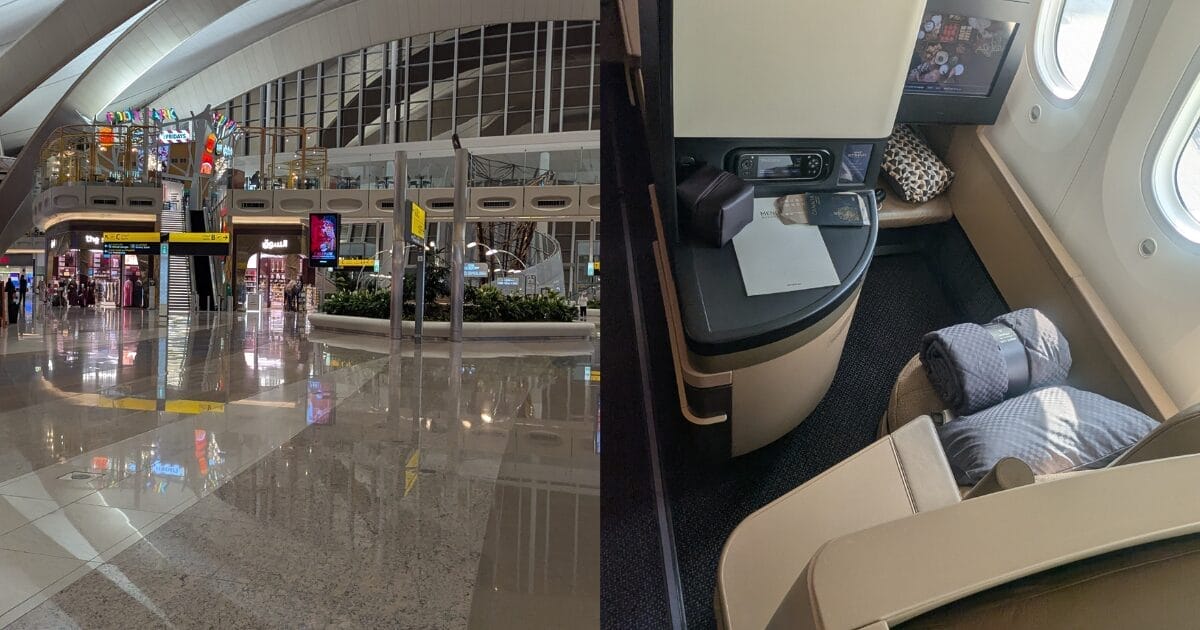
We landed at AUH around 4 AM. The airport was very empty, which is unusual in the Middle East, where there are usually so many flights around this time.
There were no sirens and no visible signs that anything was happening in the region.
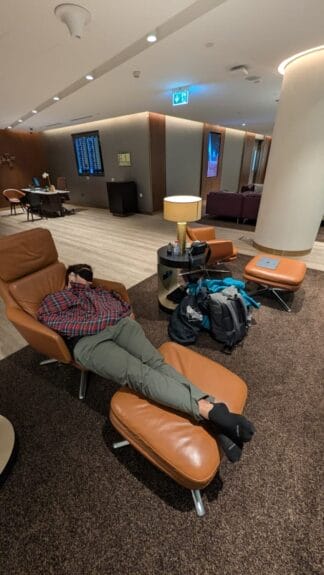
The Etihad business class lounge was particularly empty.
We tried to use their relaxation rooms for our 4-hour layover, but they were all full. So we grabbed some lounge chairs and managed about 2 hours of sleep there.
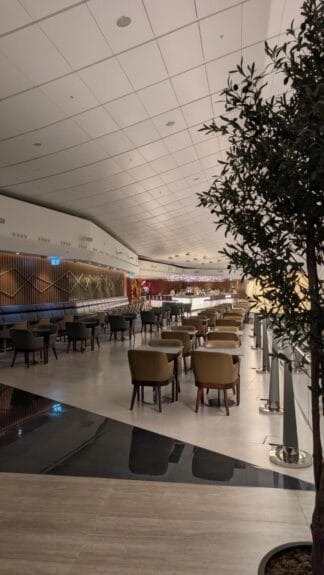
The airport was busier around the time of our Jakarta departure in the morning, but still quieter than what I’ve seen here over the last 3 times I’ve been here this year.
My 2nd flight (Abu Dhabi–Jakarta)
The second flight was on Etihad, also in business class. It was on a wide-body Boeing 787-9 Dreamliner with lie-flat seat beds for that 8h daytime flight.
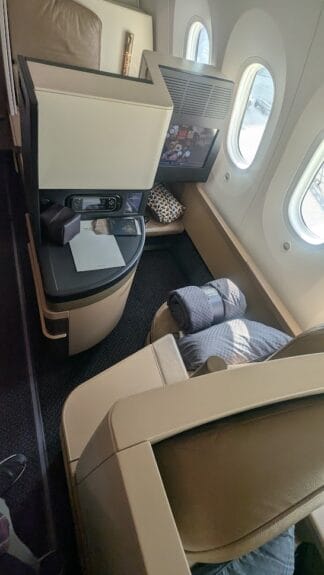
Business class is less useful on daytime flights, but I still slept for the first 3 hours because the previous night was short, so it was very nice to have a bed in the sky!
(And it’s a much savvier way to get one than the new bunk beds option unveiled by an airline last week!)
I also wanted to enjoy the very nice Etihad service and wasn’t disappointed.
The food was great.

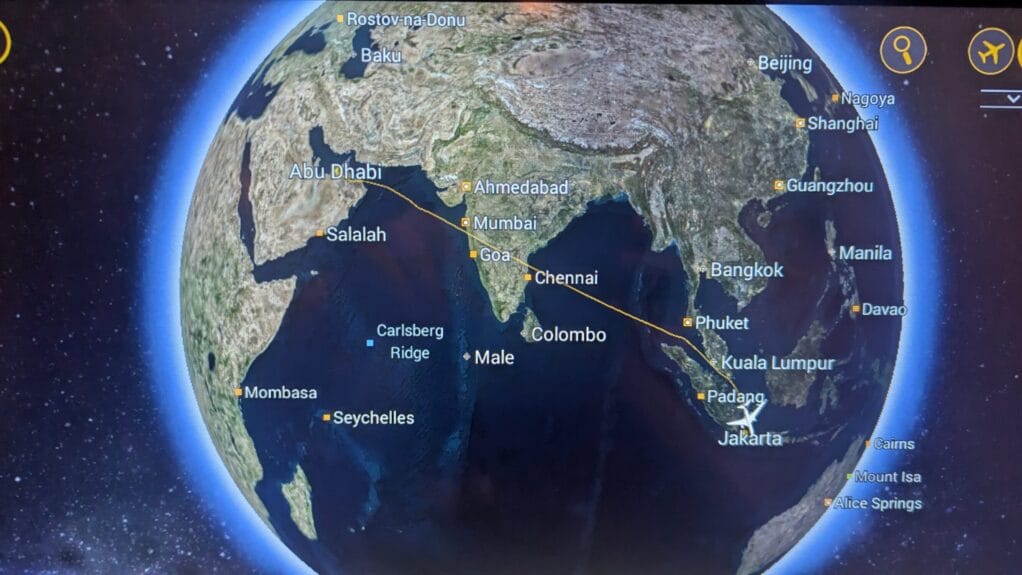
Our flight path looked normal, and there wasn’t anything unusual about this flight.
Even if there were any issues, we wouldn’t have been affected much, as only a small portion of the flight was over the UAE and Oman, which is the quickest way out of the Gulf area.
My risk assessment
I still think that the risk of something happening to your flight is very, very low. I wouldn’t put my own life in danger just to transit in the United Arab Emirates during the war.
The bigger risk isn’t missiles or drones. It’s logistics. Canceled flights, delays, and getting stranded. That’s what you should actually plan for.
Even with the ceasefire now, even if the disruption risks have decreased greatly. It could change.
Ironically, the least chaotic part of my journey was transiting through these “dangerous” airports.
The real chaos hit when we landed at Jakarta airport, which was packed with people (in comparison), and where the roof collapsed 2 days later due to heavy rain.
Everything still moved fast there despite the crowds, but the contrast was striking; fewer travelers in the Middle East means smoother airport experiences. A bit of positivity in this tragedy, like the fact that we had Petra all to ourselves.
There will also probably be good deals to be found on the major Gulf carriers in the coming months! Many people will remain scared for years after this has ended, so they’ll probably need to offer lower prices. Flytrippers will spot them for you!
Should you transit through the Middle East right now?
If you’re flexible and can handle potential disruptions? Yes. Airports are emptier, lounges are less crowded, and most routes are operating reliably.
Especially now that there’s a ceasefire. Make sure you book with a credit card that includes flight delay insurance to cover the cost of hotel nights during delays, as you always should.
But if you absolutely need to be somewhere and can’t be delayed, have a backup plan: book a backup flight. Or pre-vet options for rebooking, and be ready to pivot if the airspace closes.
We did have 2 different flights booked: the one we took and a backup flight the next day via Bangkok, in case the first one was canceled.
We also booked that backup flight with points (AAdvantage miles again), and it was also refundable for free (which we ended up doing).
Non-US airline programs (like the Air Canada Aeroplan program) generally have cancellation fees, but if you absolutely need to be somewhere, that’s what you need to do (not just during conflicts; disruptions can happen all the time).
Learning how to travel for less
Join over 100,000 savvy Canadian travelers who already receive Flytrippers’ free newsletter so we can help you travel for less (and inspire you, too)!
Sign up for our free newsletter
Sign up for our newsletter
Summary
Transiting through Abu Dhabi (United Arab Emirates) during this conflict was pretty normal. One air raid siren in Amman, empty lounges, slightly indirect flight paths, and that’s about it. And now there’s a ceasefire. Is there a disruption risk? Sure. Is it significant? Surely not.
What would you like to know about my transit in Abu Dhabi during the Iran conflict? Tell us in the comments below.
See the flight deals we spot: Cheap flights
Discover free travel with rewards: Travel rewards
Explore awesome destinations: Travel inspiration
Learn pro tricks: Travel tips
Featured image: Empty AUH and seat in a B787-9 (photo credit: Kevin Gagnon/Flytrippers)